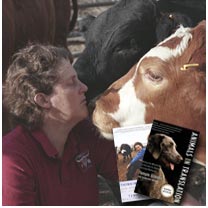
Scientist, scholar, animal rights advocate and best-selling author Temple Grandin is autistic. Temple has been profiled on 20/20, ABC News, and NPR, a well as in The New York Times, USA Today, and in the famous Oliver Sacks New Yorker profile, "An Anthropologist on Mars." Considered to be one of the most celebrated and effective animal advocates on the planet, Grandin has revolutionized animal movement systems and spearheaded reform of the quality of life - and death - for the world's agricultural animals: Grandin Livestock Systems works with McDonald's, Kentucky Fried Chicken, Wendy's and Burger King to monitor the conditions of animal facilities worldwide. Almost half of the cattle in North America are handled in a center track restrainer system that she designed for meat plants.
ANIMALS IN TRANSLATION: Using the Mysteries of Autism to Decode Animal
Behavior
"Philosophers and scientists have long wondered what goes on in the minds of animals, and this fascinating study gives a wealth of illuminating insights into that mystery.A lively and absorbing look at the world from animals' point of view."
--Publishers Weekly, starred review
Temple Grandin's extraordinary new book, Animals in Translation (Scribner; January 11, 2005), is the culmination of 30 years of professional training as an animal scientist and an innate ability, born from her very handicap, to understand the animal brain. In her inimitably clear and intimate voice, Grandin provides original insight into the animal, and the human, brain. "I have one big advantage over the feedlot owners who hire me: being autistic. Autism made school and social life hard, but it made animals easy. I'm a visual thinker. Most people are verbal, but cattle are visual and so am I."
Categorizing autism as a way station on the road from animals to humans, Grandin examines animal feelings, aggression, pain and suffering, and animal genius. She explains how animals, like autistics, never have mixed emotions: a person with a normal brain can love and hate the same person. Not animals. Not autistics. Nor can an animal make rapid generalizations from a training situation that might approximate the rest of its life. Animals have extreme perceptions: flying bats use sonar to "see" a flying beetle from 30 feet away, and dung beetles can perceive the polarization of moonlight. Her Animals in Translation lecture:
- Shows that animals-even dolphins-are capable of sadistic cruelty, remorse, superstition and surprising discernment: in one experiment, pigeons were taught to distinguish between early period Picasso and Monet.
- Compares animals to autistic savants, in fact declaring that animals may be autistic savants, with special forms of genius that normal people cannot see. Squirrels really do remember where they buried every one of their precious nuts.
- Redefines consciousness and argues that language is not a requirement for consciousness.
- Examines how humans and animals use their emotions.
- Reveals the abilities handicapped people and animals have that normal people don't.
- Maintains that the single worst thing you can do to an animal is make it feel afraid.
Temple Grandin is like no other expert on the subject of animals, because of her training and because of her autism: understanding animals is in her blood and in her bones.
Thinking in Pictures: and Other Reports from My Life with Autism
What is it like to live with autism? Temple Grandin is among the few people who have broken through many the neurological impairments associated with autism. Throughout her life, she has developed unique coping strategies, including her famous "squeeze machine," modeled after seeing the calming effect squeeze chutes on cattle. She describes her pain and isolation growing up "different" and her discovery of visual symbols to interpret the "ways of the natives". Thinking In Pictures also gives information from the frontlines of autism, including treatme medication, and diagnosis, as well as Temple's insight into genius, savants, sensory phenomena, etc.
|